Sunday, 23 August 2015

Rhythm of Life

As I sit, contentedly at our accommodation for the next 2 nights, Slow Living Sweden http://www.booking.com/hotel/se/sweden-slow-living.en-gb.html, I should catch up a bit with my version of post cards to friends that I miss hugely!

View from balcony on a warm late Sunday afternoon, Slow Living Sweden, in North Sweden.

Apart from all my gushing about the things we have seen and done, I really am struck by the connections made about peoples' lives as we travel to different countries and explore how history is acknowledged and celebrated.

Professor in Kraków, important in the revolution and given status as a mini gnome at the entrance to one of the city's universities.

We have explored a number of the "open air museums" in Tallinn, Estonia; in Helsinki (the fortress island); in Tampere, Finland; and in Stockholm. Each visit there are amazing gems of information both written and verbal at an entrance to a farm house, a room or a garden, from "hosts", usually dressed in some aspect of traditional wear from the period and very willing to answer queries and explain a bit of the history. These hosts are multilingual and nuanced in many languages, so our more bizarre questions, particularly about workers' conditions or the politics of the time, get intriguing responses that invite further conversations. I regret only photographing rather than recording what we discussed.

This was the 16c blacksmiths forge and interestingly 2 young guys were making things, and just wearing their ordinary clothes. They seemed to be simply enjoying working away at their task.

On fortress island, Helsinki.

But talking about the rhythm of life on this trip of ours would be incomplete if I didn't mention the music that we've heard. Here Karoliina Kantelinen, from her group No One's Land, based in Helsinki, sings and plays about her Karelian homeland. Beautiful music, at times teeming with joy and then, wretched in tales of dispossession.

 Karoliina playing her kantele.

So in looking at previous ways of living, we also took to the seas, and on the beautiful harbours in Helsinki and Stockholm, motored past people enjoying the last of the summer warmth.


A highlight of all this exploring was the workers' museum and the history of housing museum in Tampere, Finland. Rooms are recreated, images of people working, explanations given of conditions and struggles. We kept thinking that such museums in Melbourne would be fabulous.

Early 20c shop.

Early 20c shoe makers shop.


Some of the best experiences at these cultural museums came from the demonstrations given by local people of activities associated with schooling, herding, food preparation etc.

Local primary school students entering the Saami summer house to talk with the host about traditional Saami life.

Of course, the depiction of women's lives was great, looking at the kitchens and bedrooms and trying to imagine sharing small spaces and facilities.

Medieval bakery.

Then bliss, with the bakery demonstrating northern Swedish flatbread making, including tasting. 


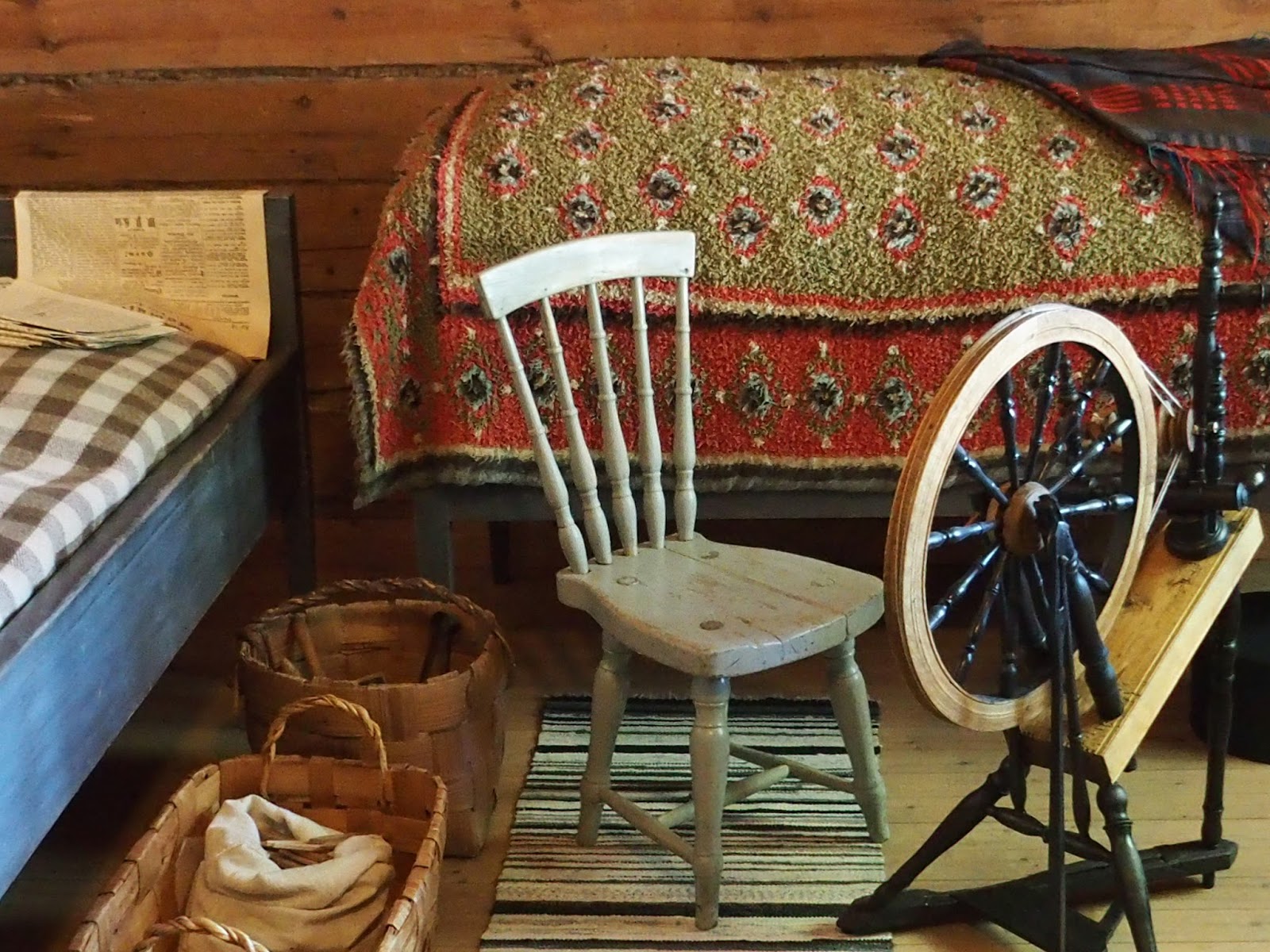
In the printer's house, one of the hosts explained to me that as an historian, whilst hosting the kitchen at the printer's house, she likes to give herself something to learn each summer that relates to the period. Last summer it was wood carving, something the whole family would do in their cold winters together. This summer it is learning spinning her own yarn.


We toured over the Vassa Museum, depicting the sinking of the great Vasa ship 20 minutes after it started her maiden voyage as a war ship in the 17c.

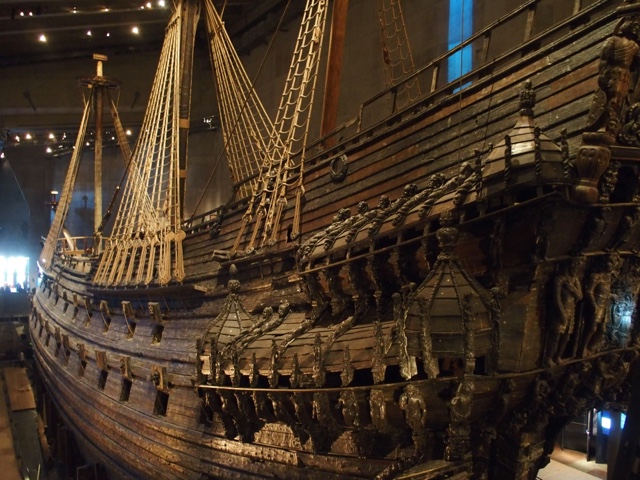
The Vasa, recovered from Stockholm harbour in the 1960s, about 80% original.

Warships were brightly painted, to be seen and feared by the enemy.

And now we are attending to our own rhythms, by relaxing for a few days in northern Sweden. Seems an indulgence after what we have learnt about people's lives.


Pat

Tuesday, 18 August 2015

Stop 15: Tampere, Finland

Tampere was (and is) a gem!  Not just because of the cute accommodation (which always shapes how we see a place), but also because of the range of museums and other attractions: things to do and see.  And there are plenty of those, leaving us with yet more to see on a future visit.

We drove there from Helsinki by a little roundabout route in order not to arrive too early. But arrive we did, in a district of older wooden houses, where we had the entire upstairs of one ... a good kitchen with balcony overlooking the garden, a large lounge room, a small bedroom for us, a bathroom and, if we needed it (which we didn't) a further bed in a mezzanine loft up some steep stairs from the bedroom.  Our charming and enthusiastic host greeted us and provided local information, including some advice about some music that was happening down town later that afternoon.


We went for a walk in the nearby forest, a track that led over a ridge to one of the lakes; Tampere sits on the area between two large lakes.  A loop brought us round and back to our accommodation.


We then headed off across and down town. This turned out to be a fairly long walk, first to the park where a band was playing some 'groove' (hmmm, nope) and then into the proper downtown area for dinner. This was at an Indian restaurant that Philip Page had recommended ... he said it was almost worth the train trip from Helsinki just for their food.  Their evening banquet was good ... perhaps not train trip good, but still very worthy.  And then we walked back to the house ... a long trekking day, so we were a little tired!

We only had two nights here, so we needed to make the most of the next day (a Sunday). Off early to church ... well, not for the service (though this was just finishing as we got there), but for the controversial frescoes in the cathedral ... modern paintings in a sort of naïve style ... skeletons tending the Garden of Death, children carrying a wounded angel on a stretcher etc.  Interesting.


Then across the river/canal/channel (old industrial area - and this water was the connection between the lakes, flowing and powering water mills) to the museum area, located in the old mills themselves.


The first was the Spy Museum - a couple of basement rooms illustrating ciphers, tapping, espionage generally ... writing in invisible ink, secret tunnels etc.  Very hands on but tons of information.  Good fun.

Then, in an adjoining building, the Workers' Museum, curated (it seems) by the union movement. This provided a fascinating social and political history of the area ... and of Finland to some extent. There was a temporary exhibition of 'Red Tampere' as well as well set-out areas on the textile weaving mills, the union halls, the water-powered engines and so on.


Lots of displays, lots of information, many buttons to push to get stories and music and videos (some with English subtitles - generally lots of English explanations). For example, there were workers' lockers that you could open to see what they brought to work, and this then triggered taped stories that told their stories (in Finnish).


There was so much to take in ... we went for some lunch in a cafeteria in the museum complex, and then came back for more.

From there, further across town to the Amuri Museum of Workers' Houses.


This was a block of old houses that has been saved and restored, when an area was being razed and low-rise apartments being built. There are some 30 dwellings, set up in roughly chronological order, giving a wonderful insight into the changes in living conditions from the early 1800s.


There are co-op shops, trades etc, as well as the apartments ... which early on, tended to be four separate one-room apartments grouped around a common kitchen. With up to 80 people living in one house!  There were people wandering around there to explain and comment on them.


And finally, a few blocks away, the Lenin Museum, outlining Lenin's life, as well as the occasions when he was in Finland (underground).


Huge amounts of material in display cabinets ... translations of the Finnish display notes in a large folder, but was it museum-overload, or the fairly dry presentation? It was a valuable museum if you were a total Lenin scholar, but after a while, we were wandering through with a somewhat dazed expression.

Back to the house, and later we took a bus into town for a Thai/Lao meal and then bussed back again.

And there was a sense of a lot of other things to do: lots of other museums in the complex, but also whole areas off Tampere that we didn't go to, such as the ridge between the two lakes where there's apparently a great view over the town. We need to come back.

The Next Day


We headed off towards the ferry from Turku to Stockholm. This wasn't to leave until almost 9 pm, so we planned a longer route via the coast. On the way, we dropped in on Arto Järvelä, top Finnish folk fiddler and nyckelharpa player - who we'd met in Melbourne in the early 1990s. We'd promised then that we'd come and visit so, some 22 years later, here we were. It was fabulous to meet him and Varpu again for lunch.

Arto suggested we also visit the small coastal town of Rauma, so we drove there. Because of luggage in the car, these was a quick drive through of the old town - a vast area of coloured wooden buildings. It was magnificent, if a little 'precious', but we'd like to come back and stay there sometime.

Then finally on to Turku via some back roads and down to the docks, still quite early, for a long wait until boarding commenced and we were on. We had a double cabin with a giant window, and we could watch the islands gliding past, some very close to the boat, until it got dark.


On to Stockholm ...


Thursday, 13 August 2015

Stop 14: Helsinki, Finland

Helsinki: so much to do and so little time.  We've finished up not visiting some of the sights we intended to ... but had a great time including hearing some good music and catching up with people.

The ferry from Tallinn was straightforward, until we reached Helsinki.  


And then it was very slow disembarking us ... and again, big roadworks just north of the downtown area meant we crawled towards our apartment in the Kumpala/Käpylä area. But we made it, a little late, and our host was waiting to wave us into a parking space and introduce us to our apartment ... looking out onto some wooded areas. 


A great neighbourhood, with some older wooden houses and good transport connections to downtown, but singularly lacking in restaurants that were open after 8 pm. (So it was takeaway pizza one night, takeaway Egyptian falafel another, and takeaway Thai a third night - not bad out of four nights in town.)

During our stay, we met up with a few new and old friends: Sanna, an academic who I (Roger) had met through the Youth Research Centre at Melbourne University - and went for a drink locally with her and her husband on our first night; with Philip Page, manager of Kimmo Pohjonen, in an old bar (Corona Bar) downtown; and with Karoliina Kantelinen (also locally at a little pop-up kiosk on the edge of a nearby park), singer with the group NOL etc, who we saw with that group at a free concert (part of Etno-Espa) in the downtown Esplanade (more on that in a moment): http://www.karoliinakantelinen.fi .


We'd been alerted by Sanna to this series of free concerts that were happening late afternoons in the small park that runs off the downtown Market Square (on the harbour). We caught two afternoons' of these. The first had the trio Celenka playing Finnish and Balkan music for voice, kantele, trumpet and harmonium: http://kuurecords.com/en/ .  After their lovely and interesting set, we chatted with Emmi Kujanpää (singer, kantele) and Jarkko Niemelä (trumpet, singer) from the band and got a copy of their impressive CD. 


The second group that evening were NOL (No One's Land), with Karoliina fronting the group (ex-Värttinä). Again, an interesting mix of Finnish and Bulgarian sounds. 


However, the threatening rain realised into heavier showers and, unprepared, we retreated to the tram back to the apartment before their set finished. We did, however, then e-mail Karoliina and, as noted above, this resulted in meeting her the next day to chat and get copies of some of her releases.

The next afternoon, we again heard some interesting music at this Etno-Espa concert series: first a Sami duo presenting some Sami pop ... interesting, but not our thing, especially as their explanations, initially in English as well as Finnish, 'dried up' and all we heard were covers of American pop sung in Sami.


They were followed by a Nepali quartet ... again, interesting to hear for a while, but not that engaging ultimately.


So we broke away early and took an early evening ferry ride around the Helsinki bay islands ... a long and enjoyable water trip ... with blankets to keep us warm!!


Afterwards we hunted for something to eat downtown and finished up in a Chinese restaurant.  So, our Helsinki dinner eating experiences were typically Finnish ... not! Though two occasions where I had salmon soup for lunch made up for this a little.

We spent another day out on Suomenlinna, the Sea Fortress island. This is a short public ferry ride across the bay and has some great sights and walking, as well as giving a good view back to the Helsinki old town ... and the cruise ships.


It took a few hours to walk from one end to the other and back again, popping into some of the highlighted areas, and stopping for drinks and lunch.


Of course I dropped into Digelius Records briefly ... and was self-restrained.  And we saw some perhaps 'spontaneous' choirs on the street downtown one evening ... without any knowledge about what that meant.


After a wander around the nearby Arabia quarter, where factories have been turned into design museums and outlet shops, and new smart design waterside apartment built:


our final 'excursion' from Helsinki was a drive to the small town of Porvoo, eastwards along the coast. It's quite close to Helsinki and hence an easy day trip. The old town is made up of painted wooden houses ... quite pretty, but there was a sense that we were staying (or had stayed) in similar districts, so the novelty had worn off, and this was very tourist-oriented.


So we wandered along the riverside for a short way, had some lunch, and drove back.

But we didn't visit the churches or museums on our list ... and the #3 tram (which became #2 halfway around the loop, and then reverted to #3 elsewhere) provided us with a bit of a circular look at the city's layout. This convinced us that Helsinki deserves a longer stay at some future time.
x